Crude differentials shift in minutes. Refinery constraints flip overnight. RIN credits whipsaw with the regulatory wind. Yet most refiners still value cargoes on data that's half a day old. Here's how the energy companies winning today are using the Databricks Data Intelligence Platform to close the gap — and why the rest are about to find out it's already too late.
A senior crude trader once told us the most expensive sentence in the refining business is "Let me get back to you on that." By the time the data caught up, the differential had moved, the cargo was gone, and so was the margin.
That sentence is becoming extinct. A new generation of refiners and integrated energy companies is rebuilding their crude valuation, refinery analytics, and trading platforms on the Databricks Data Intelligence Platform — and the gap between them and everyone else is widening fast.
This isn't a story about moving data warehouses to the cloud. It's a story about turning the refinery itself into a real-time decision engine.
1 / THE PROBLEM
Five sources of truth, none of them true.
Walk into the analytics function of a typical mid-to-large refiner and you'll find the same architectural fossil record: an ETRM system humming away in a corner, a SCADA historian no one has touched in three years, a refinery yield model living inside an Excel workbook with macros that only one retiring engineer understands, a compliance tool tracking RIN/LCFS exposure on its own island, and — somewhere — a data warehouse full of last quarter's reports.
The data exists. The intelligence does not.
Reconciling the five sources to value a single crude cargo can take 4 to 12 hours, and by the time the answer arrives, the spot market has already repriced the question.
Worse, every refiner in the fleet is running the same exercise on slightly different inputs, producing slightly different fair values, and the trading desk is left to interpolate.
In a market where basis differentials can compress $2/bbl on a single weather event and freight rates spike on a single Suez headline, that latency isn't a nuisance — it's a tax on every barrel purchased.
“We weren't losing money on bad decisions. We were losing money on slow ones.”
— VP Supply & Trading, Top-10 US Refiner
2 / THE BLUEPRINT
One Lakehouse. Every barrel. Every price. Every refinery.
The Everforth Apex playbook for energy clients starts with a deceptively simple thesis: collapse the five-source mess into a single governed Lakehouse, then layer real-time intelligence on top of it.
We don't replace the ETRM. We don't rip out SCADA.
We integrate, ingest, govern, and let Delta Lake do what no traditional warehouse can: serve streaming and batch from the same table, with ACID guarantees, time travel, and full lineage.
The Architecture in Four Moves:
- Unified Delta Lake: All crude valuations, yield detail, logistics, and processing costs land in a single governed Delta schema with ACID, time travel, and full audit history.
- Streaming Market Intake: Spot prices, futures curves, basis differentials, freight rates, and RIN/LCFS feeds flow through Delta Live Tables, refreshed in seconds — not hours.
- Multi-Variable Fair Value: Five cost layers stacked per crude × refinery: gross product value, operational, logistics, constraint, and historical adjustment. Updates continuously.
Genie Natural Language: Any planner asks any question in plain English. AI/BI Genie returns SQL, charts, and answers — grounded in proprietary data, no hallucinations.
3 / THE NUMBERS
What "real-time" actually buys you.
The transformation is easy to romanticize and difficult to quantify — until you put the before-and-after side by side. Across the energy clients Everforth Apex has migrated to Databricks, these are the numbers that show up consistently:
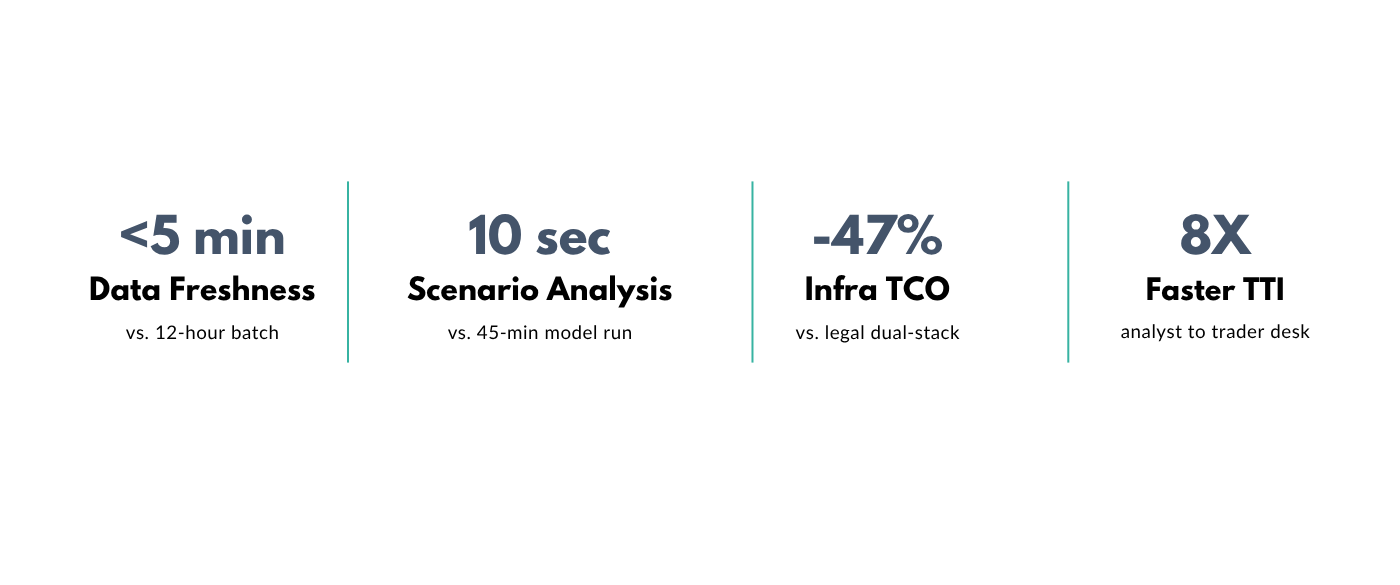
These aren't hypotheticals. They're the median outcomes from production deployments across ERCOT-adjacent merchant power, PADD-II refining, and West Coast downstream operations. The headline savings are infrastructure, but the leverage point is decision velocity: when a trader can run a what-if in 10 seconds instead of waiting 45 minutes for a quant to rerun a workbook, behavior changes. Trades that wouldn't have been considered get considered. Margin that would have leaked gets caught.
| Capability | Legacy Stack | Databricks Lakehouse |
|---|---|---|
| Crude valuation latency | 4 to 12 hours | Real-time |
| Pipeline Development | 8-12 weeks | 2-3 weeks |
| Self-service analytics | Ticket queue; days | Natural language; seconds |
| Governance and lineage | Manual; fragile | Unity Catalog; automatic |
| ML model deployment | 6-8 weeks | 3-5 days |
| Compute cost (batch) | Always-on cluster | Spot autoscale, -30% |
4 / THE EDGE
Why Databricks is a good choice.
Energy data has a personality problem: it wants to be four different systems at once. A streaming engine for tick-level prices. A heavy batch compute platform for yield model recalibration. A governance layer for FERC and RIN/LCFS audit trails. An ML platform for price forecasting and constraint prediction. Most platforms are good at one. A few are passable at two. Only the Databricks Lakehouse is genuinely built for all four — and that matters more in energy than in any other vertical.
- The four pillars: Delta Lake unifies streaming and batch in a single table, so your yesterday-end-of-day numbers and your right-now spot prices live in the same schema. Unity Catalog makes every column auditable, every query traceable, every PII or commercially sensitive field governable across cloud providers. Photon accelerates SQL workloads to the point where interactive dashboards over multi-billion-row history become not just possible but pleasant. Managed MLflow and Model Serving move forecasting models from notebook to production in days, not quarters.
The platform tax — the operational overhead of running four separate stacks and reconciling between them — disappears. What replaces it is a single source of truth that every persona in the organization, from quant analyst to supply planner to CFO, can trust and query.
5 / THE FINOPS
Cloud cost is a feature, not a bill.
Energy data is volume-heavy and spiky. Intraday tick data accumulates fast. Backtests can chew through compute at terabyte scale. Left ungoverned, cloud costs follow. Databricks treats cost as a first-class architectural concern. SQL Warehouses autoscale to zero between queries. Photon compresses workloads that used to span overnight batch windows into minutes. Spot/preemptible compute on batch jobs delivers an additional 30% savings on top of the baseline reduction.
More importantly, the platform makes cost observable. Tag every job, every cluster, every warehouse by trading desk, refinery, asset class, or regulatory report. Build chargeback dashboards that route real numbers to the people running real budgets. FinOps stops being a quarterly reckoning and becomes a continuous operating discipline.
6 / THE FRONTIER
From decision support to autonomous intelligence.
The platform we've described so far is decision support — it puts better information in front of a human decision-maker, faster. The next frontier, already being built with early Everforth Apex clients, is autonomous: AI agents that watch the market on the trader's behalf, flag emerging anomalies, and surface draft recommendations before the human even thinks to ask.
With Databricks Agent Bricks, energy companies can build production-grade agents that monitor RIN/LCFS price movements, detect freight rate spikes, anticipate refinery constraint changes from operational telemetry, and notify the trading desk the instant a basis shift materially re-rank the crude slate. This is not a chatbot. This is a market sentinel — grounded in proprietary data, governed by Unity Catalog, and continuously evaluated against historical outcomes via MLflow.
The energy companies adopting this now will have a structural advantage that compounds every quarter. The ones waiting will spend the next five years trying to catch up to where the leaders are today.
Your data is already an asset.
Make it a competitive weapon.
Everforth Apex is a Databricks partner with deep energy domain expertise — ERCOT, PJM, CAISO, PADD-II refining, midstream, and integrated downstream. We've built production Lakehouse platforms for the kinds of trading floors where minutes equal millions. We can do it for yours, faster than you'd expect.