The clock on post-quantum cryptography started long ago. Most organizations simply haven't looked at it.
There is a comfortable myth circulating in boardrooms and IT planning sessions: that quantum computing is a problem for the next decade, that the threat is theoretical, and that any serious response can be deferred until the technology arrives. On close inspection, the myth falls apart. Adversaries are not waiting for cryptographically relevant quantum computers to exist before they act. They are acting now, today, in ways that put data with a five-, ten-, or twenty-year sensitivity horizon at risk.
This article unpacks what is actually happening, why the threat is more immediate than most leaders appreciate, what regulators are demanding, and how organizations can begin a quantum-ready roadmap that controls cost, manages complexity, and avoids the trap of crisis-mode migration.
Harvest Now, Decrypt Later: The Threat That Already Exists
The single most important concept for executives to internalize is “Harvest Now, Decrypt Later,” (HNDL). The premise is simple. State-level adversaries, sophisticated criminal groups, and other well-resourced threat actors are intercepting and storing encrypted data today, with the explicit expectation that quantum computing will eventually allow them to decrypt it. They don’t need a quantum computer in 2026 to compromise you. They only need the patience to sit on stolen data until one exists.
This reframes the entire conversation. The question is no longer “When will quantum computers break public-key cryptography?” The question is "What data are we sending or storing today that will still be sensitive when that capability arrives?"
Most organizations can’t answer a basic question: what cryptography exists in their environment, and how is it protecting “critical” data?
For most organizations, the answer is unsettling. Intellectual property, financial records, health data, customer information, classified communications, source code, contractual terms, merger documentation all have a sensitivity lifespan that extends well beyond any reasonable estimate of when quantum decryption becomes practical.
Cryptography has historically been treated as a forward-looking control: encrypt the data, and it stays protected for the lifetime of the algorithm. Under HNDL, that assumption breaks. Today's encryption choices determine whether tomorrow's adversary can read yesterday's data. The window for action closed before most organizations knew there was a window.
The Compliance Mandate is Non-Negotiable
There are Federal mandates and Commercial pressures causing cybersecurity leaders to think about quantum now. The Federal government has set a deprecation deadline of 2030 for quantum-vulnerable cryptography. And recently, Google sounded alarms to the industry by announcing their own post-quantum encryption timeline has moved up to 2029. Commercial companies are compelled to keep up with the Federal mandates because they risk losing future business.
If your sensitive data has a five-to-ten-year confidentiality requirement, which is conservative for most regulated industries, anything you encrypt with vulnerable algorithms today is already exposed. The intelligence community assess the data collections, aka “harvest. And with harvesting is happening in real time, organizations will soon need to prove their compliance.
More on this later. First, let’s discuss the problem at hand – the visibility gap.
The Visibility Gap: You Can’t Protect What You Can’t See
If the threat is the first problem, visibility is the second, and in many ways the more immediate one. Before any organization can migrate to post-quantum cryptography, it needs to answer a deceptively simple question: where, exactly, is cryptography being used in our environment, and what algorithms, key lengths, and protocols are in play?
For nearly every organization, the honest answer is we don't really know.
5-10+ Years of Data Lifespan Already at Risk Today
2030 Federal Deadline to Depreciate Vulnerable Crypto
Gartner has noted this in recent years, stating that most IT organizations are not aware of the type of encryption they are using. Cryptography is the foundation of nearly every other security control an organization deploys, and most organizations cannot describe their own foundation. Remarkable.
The instinctive response is, of course, to commission an inventory: run a workshop, build a spreadsheet, list every system and every certificate. Most organizations that try this discover the same thing: the spreadsheet is obsolete before it is finished. Certificates are issued, applications updated, libraries pushed, configurations drift. A manual inventory produces a static snapshot of a continuously moving target, and within weeks it has decayed into a document worse than nothing, because it creates the illusion of visibility while the underlying reality has moved on.
Without ground truth that is both comprehensive and continuously refreshed, three things become impossible:
- You cannot plan a migration, because you don't know what you're migrating
- You cannot demonstrate compliance, because your evidence is stale on the day you submit it
- You cannot detect drift, meaning configurations that degrade toward insecure states do so silently.
The visibility gap is the prerequisite problem. Until it is solved, every other quantum-readiness initiative is built on sand.
Regulatory Pressure Is No Longer Theoretical
For organizations that prefer to act when regulation forces their hand, that moment is arriving fast. The regulatory landscape around post-quantum cryptography has shifted decisively from advisory to mandatory, and the mandates are accelerating across both federal and commercial domains.
On the federal and defense side, National Security Memorandum 10 directs the deprecation of quantum-vulnerable cryptography by 2030. OMB Memorandum M-23-02 requires agencies to inventory and prioritize their cryptographic systems. This is not at some point in the future, but on a defined cadence with reporting obligations attached.
Additionally, the NSA's CNSA 2.0 guidance establishes requirements for national security systems, and The Quantum Computing Cybersecurity Preparedness Act imposes congressional mandates on agency action.
The commercial sector is not far behind, and in some respects is moving faster because the pressure comes from multiple directions at once.
- Supply chain requirements are expanding. Vendors selling into federal agencies and security-conscious commercial buyers are being asked to disclose their post-quantum readiness posture, cascading deadline pressure down through every tier.
- Cyber insurance underwriters are beginning to assess quantum-era exposure in their risk models, which will translate into premium increases or coverage restrictions for organizations that cannot demonstrate a credible plan.
- Industries holding long-lived sensitive data, such as pharmaceutical research, financial services, healthcare, intellectual property are recognizing that HNDL risk is a board-level disclosure issue.
- And for organizations that sell trust as part of their product, proactive quantum readiness is increasingly a market-differentiating signal rather than a back-office compliance task.
The cumulative effect is that quantum readiness is becoming imperative. Organizations that wait for regulation to apply directly to them will end up migrating under pressure, on someone else's timeline, with their negotiating leverage stripped away.
The Business Case: Why Starting Beats Waiting
Migration to post-quantum cryptography is going to happen for every organization that handles sensitive data. The only question is whether it happens on the organization's terms or as an emergency response.
Waiting until regulations land hard, until a breach forces action, or until a vendor or customer demands evidence produced a predictable cost. SentinelOne reported, in 2026, the cost of a data breach is now up to $4.44 million.
Once the alarms are sounded it’s really too late. Cryptographic changes will be rushed, which means outages and rollback events. An early approach can safeguard IT teams, executives, and board members from playing emergency room doctor on their systems.
Our recommendation is to first establish automated cryptographic visibility. This is a relatively low cost and produces immediate value even before migration work begins. The very act of discovering your cryptographic estate surfaces classical hygiene issues that need fixing anyway: expired certificates, weak cipher suites, deprecated protocols, drifted configurations. These are wins the security team can bank on day one, independent of any quantum timeline. From that baseline, migration becomes a phased, planned activity rather than a forced march, and compliance posture is defensible from the start.
The cost of starting is the cost of a discovery exercise and a roadmap. The cost of waiting is everything that flows from doing complex cryptographic surgery under time pressure, in public, with regulators watching.
A Practical Roadmap: From Blind Spot to Quantum-Secure
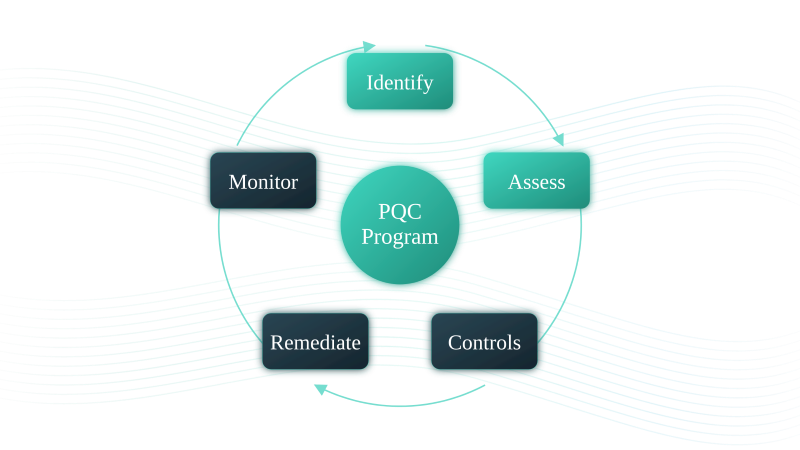
To help organizations begin, and drawing from the overlapping guidance of CISA, NSA, and NIST, a five-phase model can help organizations adapt:
- Identify
- Assess
- Controls
- Remediate
- Monitor
The journey looks like this:
- Identify: The work begins with automated cryptographic inventory aimed at establishing ground truth — a Cryptographic Bill of Materials (CBOM) cataloging every algorithm, key, certificate, cipher suite, and library across the environment. Manual approaches do not work at scale; the inventory must be automated and capable of continuous refresh. Endpoint discovery, passive network traffic analysis, and integration with existing SIEM and endpoint-management platforms together produce a picture that is comprehensive and durable rather than static.
- Assess: With a baseline in hand, the next step is risk scoring and compliance gap analysis. Not every cryptographic asset carries the same weight — a long-lived signing certificate protecting code distribution is a different risk profile from an ephemeral TLS session between internal services. Assessment prioritizes by quantum vulnerability, by the sensitivity and lifespan of the data being protected, by the difficulty of replacement, and by exposure to regulated workflows. The output is a heatmap that converts raw inventory into actionable priority.
- Controls: This is where the organization tests NIST-standardized post-quantum algorithms — FIPS 203 and FIPS 204 are the early anchors — in controlled pilots. The goal is to validate that target algorithms work in the organization's actual environment, surface integration issues early, and refine the roadmap with real data. Most organizations will operate in hybrid classical-plus-PQC modes for an extended period, and the pilot should validate that hybrid posture.
- Remediate: Phased rollout begins with the highest-risk, highest-value assets identified during assessment, sequenced to align with vendor roadmaps, federal deprecation dates, business cycles, and dependency maps. This is multi-year work for any significant enterprise, which means program management discipline matters as much as cryptographic engineering. Most large-scale transformation initiatives lose momentum within twelve months; quantum migration is not exempt, and governance must be designed to sustain progress across the full timeline.
- Monitor: Cryptographic visibility cannot be point-in-time. Continuous discovery keeps the inventory current. Automated drift detection catches regressions — new applications deployed with weak defaults, certificates renewed with deprecated algorithms, configuration changes that quietly undo earlier remediation. Validated remediation confirms that migrations achieved their intended outcome rather than merely being marked complete in a project plan.
Crypto-Agility: The Capability That Outlasts the Migration
There is one more concept worth emphasizing. The deeper capability to develop is crypto-agility, the organizational ability to change cryptographic algorithms across the enterprise without requiring a multi-year project each time.
The reason this matters is that the post-quantum transition is not the last cryptographic transition that will ever happen. NIST's standardized algorithms today will not be the final answer. New algorithms will be standardized, weaknesses will be found in current ones, hardware will evolve, and operational requirements will change.
Organizations that treat the current migration as a one-time event will find themselves rebuilding the same capability ten years from now under similar pressure. Organizations that treat it as the moment to build durable crypto-agility get something far more valuable than a successful migration.
What to Do This Quarter
For leaders wondering where to start, three concrete moves are appropriate this quarter, regardless of current maturity.
First, get an honest read on what is known and unknown about the cryptographic estate. You don’t necessarily need a complete inventory today. An executive-level conversation about who owns cryptographic decisions, what visibility exists, and what the gaps are is a good place to start. But be prepared, because the answers will be more uncomfortable than expected. That discomfort is the signal that the work is needed.
Second, identify the data assets most exposed to HNDL risk: long-lived intellectual property, regulated records, signing keys protecting code or identities, anything with a confidentiality lifespan beyond five years. These are the priorities, and knowing them sharpens every subsequent decision.
Third, treat the first phase, discovery and inventory, as a near-term security hygiene investment rather than a long-term quantum project. The classical wins pay for the effort independently of any quantum timeline.
Conclusion
Quantum-relevant cryptography is coming. The 2030 federal deadline is closer than it sounds, regulatory pressure is intensifying across commercial sectors, and adversaries are already operating on the assumption that today's encrypted data is tomorrow's intelligence product. The organizations that will navigate this well are the ones that start now.
This article was written with contributions from John D'Agostino and Amiel De Guzman